Blog
News and field reports


Alternatives to Two-Way Radio: In Place of the Radio, or Alongside It?
What can be used instead of two-way radio? Where radio is strong, its limits on data, options such as cellular push-to-talk and mission-critical broadband, frequency permits in Türkiye, and adding a written layer next to radio step by step. With CISA, SAFECOM and 3GPP sources.
Read the post
Disaster Communication Plan: A Step-by-Step Guide for Organisations and Municipalities
A disaster communication plan for organisations and municipalities: linking to the provincial response plan, staff status reports, informing the public, a channel inventory, drills and updates. With Turkish regulation, the ITU guidelines and Kahramanmaraş research.
Read the post
Security Team Communication: Between Patrols, the Control Room and the Police
A communication guide for private security and facility security teams: the patrol, control room and police rings, the reporting rules of Turkey’s Law No. 5188, the protection and security plan, lone officers, shift handover and blind spots.
Read the post
Field Team Communication Plan: Who, to Whom, Over Which Channel
A guide to communication plans for field teams: a role-based contact list, a channel table, the PACE backup channel order, check-in intervals, Turkish emergency rules and drills. With ICS 205/205A and CISA examples.
Read the post
Disaster Response Coordination: Plans, Centres and Roles
How disaster response is structured in Türkiye: TAMP, four services, service groups and solution partners, coordination centres, incident and unified command, lessons from Kahramanmaraş research and a communication plan.
Read the post
Solving Communication Breakdowns: Channel, Message, Receiver and Handover
A guide that splits communication breakdowns into four sources: channel, message, receiver and handover. Turkish emergency rules, the NIMS plain language principle, closed-loop confirmation, HSE handover principles and backup channels.
Read the post
Information Sharing Between Teams: One Picture, One Language, One Channel
How information should move between teams: JESIP's five principles, a common reporting format, group arrangement by information type, Turkish coordination law and continuity when the network drops.
Read the post
How to Manage Field Teams Remotely: Roles, Check-ins and Records
The four parts of remote management: roles and chain of command, check-ins, task and location visibility, records. A step-by-step setup order drawing on NIMS, HSE, Turkish law and ILO guidance.
Read the post
Secure Team Messaging: A Step-by-Step Guide for Organisations
The four layers of secure team messaging, the risks of groups on personal apps, the KVKK notice and Circular 2019/12, selection criteria and a step-by-step setup order.
Read the post
Energy Site Team Communication: A Guide for Line, Substation, Wind and Solar Crews
The flow of de-energising and re-energising messages, the pre-job briefing, lone working rules, the communication side of the emergency plan and channels for line, wind and solar sites.
Read the post
Indoor Communication: A Guide to Team Communication in Buildings, Basements and Tunnels
Building entry loss, the hardest indoor spaces, announcement and mine communication rules, options that carry the signal in or build a network inside, and planning for the worst point.
Read the post
Alternative Communication Methods: 8 Backup Channels for Organisations
Second operator, landline, backup internet, licence-free and professional radio, satellite, mesh and amateur radio volunteers: backup channels and how to choose them.
Read the post
Operation Data Logging: What to Record, When and How
Five data types in an operation log, records required by law, the structure of a good activity log, retention and destruction rules, logging without a network and after-action review.
Read the post
Communication in Crisis Management: Plan, Roles and Backup Channels
Communication across the three stages of a crisis, spokesperson and command roles, six principles for the first message, a tiered channel plan and records for learning.
Read the post
How to Choose and Use a Mobile Field Communication App
Comparison criteria, the background limits phones impose in a pocket, data protection for location records, a realistic field trial and embedding the app in your team.
Read the post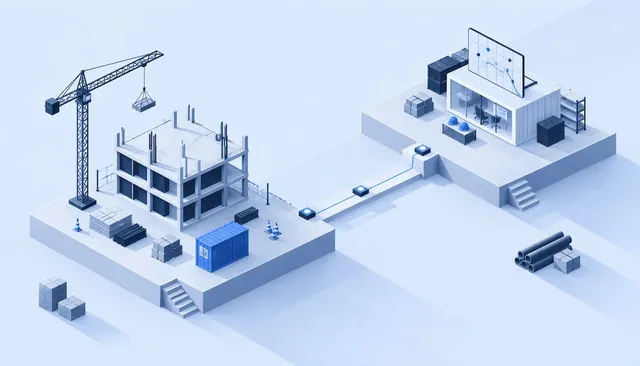
Construction Site Team Communication: A Guide to Coordination That Holds
The chain of responsibility, morning meetings and shift handover, the emergency alert flow, employer obligations and choosing a channel that works in basements and tunnels.
Read the post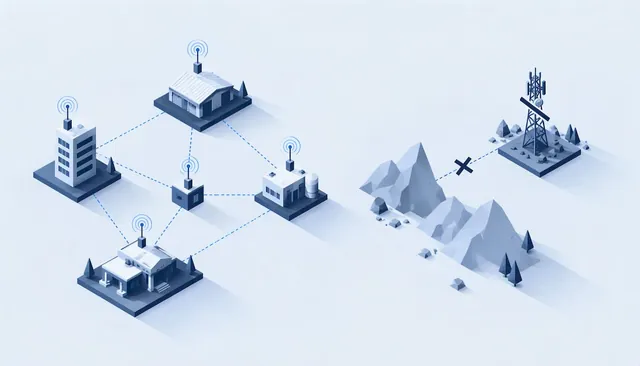
Emergency Notification Systems: Types, Selection and Working Without the Internet
The difference between AFAD’s public warnings and in-team emergency alerts, what to look for when choosing a system, and the device-to-device mesh option for when the network goes down.
Read the post
What is infrastructure-free communication?
How does a team communicate when the network is down or was never there? What infrastructure-free communication is, how satellite, radio and mesh compare, and where the limits lie.
Read the post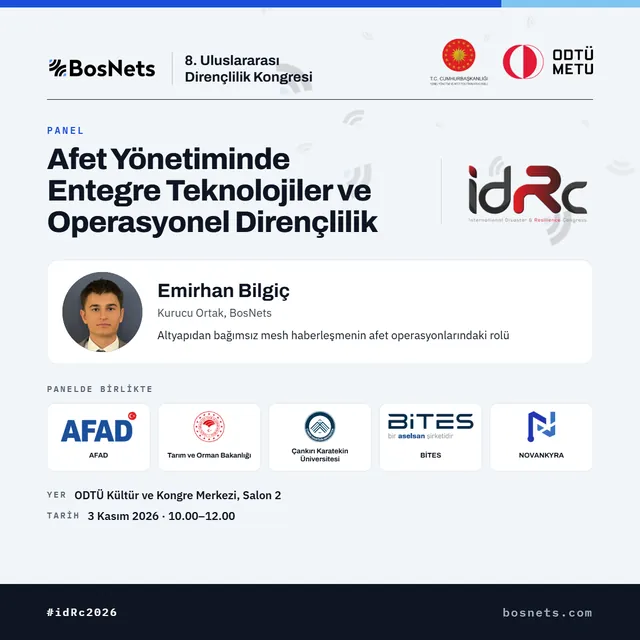
idRc2026: we're speaking at the 8th International Resilience Congress
We'll be at METU on 3 November. On the idRc2026 panel “Integrated Technologies and Operational Resilience in Disaster Management”, we join AFAD, the Ministry of Agriculture and Forestry, Çankırı Karatekin University, BİTES and NOVANKYRA to discuss infrastructure-independent mesh communication.
Read the article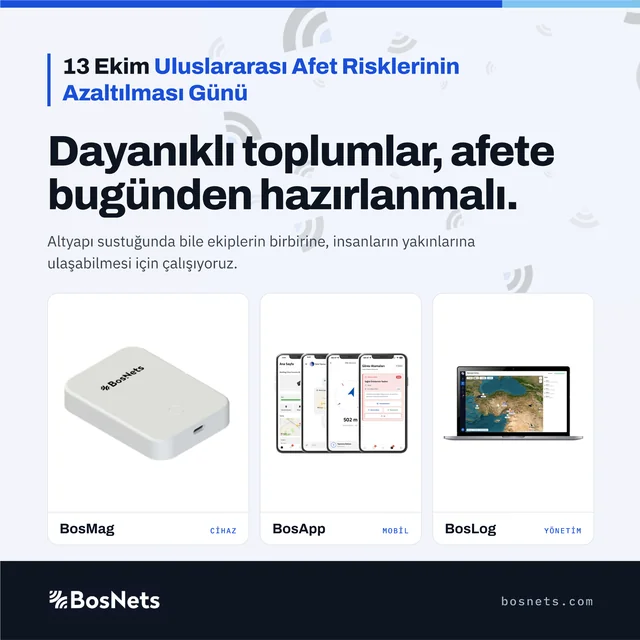
Disaster Risk Reduction Day: resilient communities prepare today
We cannot always prevent disasters, but we can reduce their impact. On 13 October we look at the most critical part of preparedness: communication that holds even when infrastructure goes silent.
Read the article
Field communication system buyer’s guide
Which technical criteria should be compared before buying a field-deployable system? Frequency band, range, encryption, battery, setup time and infrastructure independence — with the BosNets value for each.
Read the article
What is a tactical mesh network?
How does an architecture that creates multi-hop links between devices without fixed infrastructure work, and where is it used in disaster and security operations?
Read the article
Post-earthquake emergency communication
After an earthquake the network is lost in two stages. How is communication kept running in the field from that moment on? A step-by-step deployment summary.
Read the article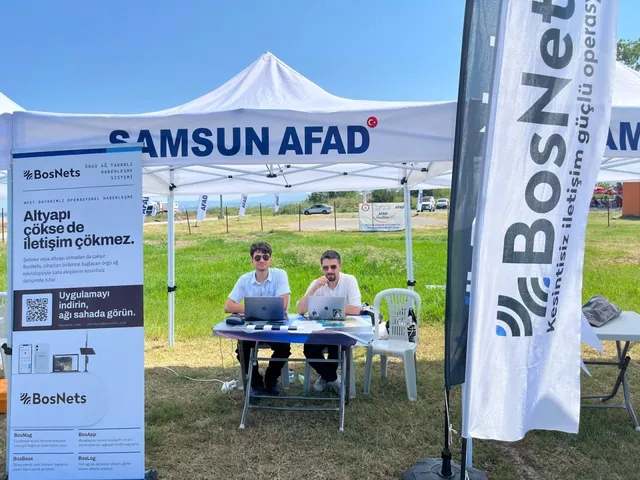
Four days at AFAD's drone search competition
We were in Samsun from 17 to 20 August. Search and rescue teams from all 81 provinces looked for hidden objects by drone, and for four days we watched how those locations travelled from the field to the coordination centre.
Read the post
Hybrid and bridge communication
What does it mean to work over the internet where there is coverage and over the devices’ own network where there is none? And how does one person inside coverage connect an entire team that is outside it?
Read the post
What is a mesh network?
A network where devices connect directly to each other instead of to a centre. How it differs from a mobile network, why it gets stronger as it gets busier, and where its limits are, explained with diagrams.
Read the post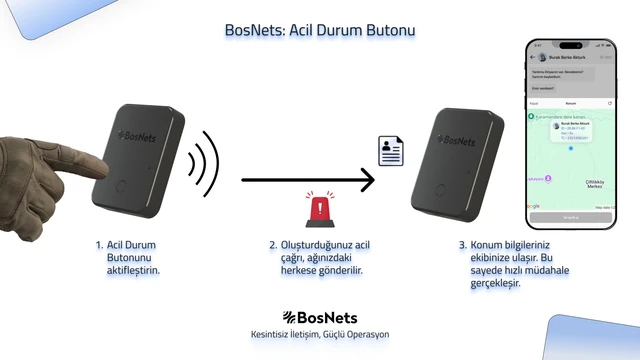
The emergency button: one press, the whole team knows
In field operations the worst case is not getting injured, it is being unable to tell anyone. What happens when the physical button on the device is pressed?
Read the post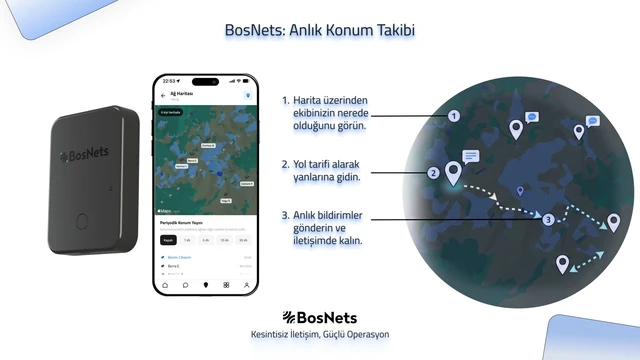
See where your team is without asking "where are you?"
How do you follow team positions in the field with no coverage? The team on a map, periodic location broadcasting, offline maps and routing.
Read the post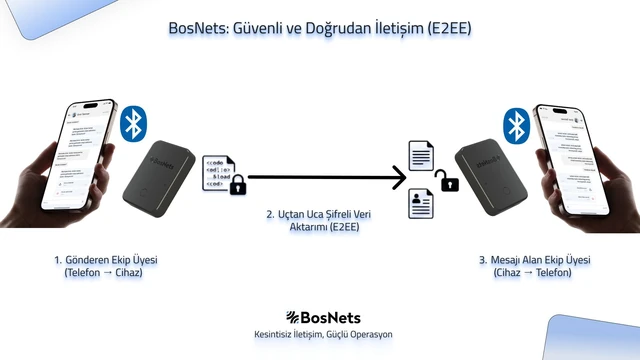
A private, closed communication network
What end-to-end encryption actually means, what independence from outside infrastructure buys you, and how an organisation runs its own communication network.
Read the post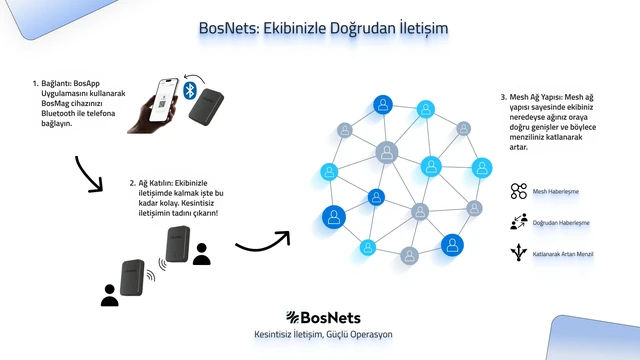
How to reach your team without a base station
How do you set up team communication where the network has collapsed or coverage never existed? A chain that works in three steps.
Read the post
What is BosNets? Communication that works when the network is down
In the February earthquakes, 2,800 of the 6,350 base stations in the region went out of service within seconds. Why does the network vanish exactly then, and what does BosNets put in its place?
Read the post