The confidentiality of communication, the continuity of the connection and the flexibility of the infrastructure decide whether a critical field operation succeeds. All three are faces of the same question: who controls the network?
Why a closed network
In a critical field operation, communication has to achieve three things at once: what is said must not leak, the connection must not drop in the middle of the operation, and the organisation itself must decide who is on the network.
Commercial networks hand all three to somebody else. Coverage depends on the operator's investment, continuity on the resilience of their infrastructure, and the rules of the network on a subscription contract. For everyday use that is fine. In a critical operation each of them is a risk sitting outside your control.
That is why BosNets builds the network inside the organisation. There is no operator to subscribe to and no external infrastructure to connect to.
What end-to-end encryption actually means
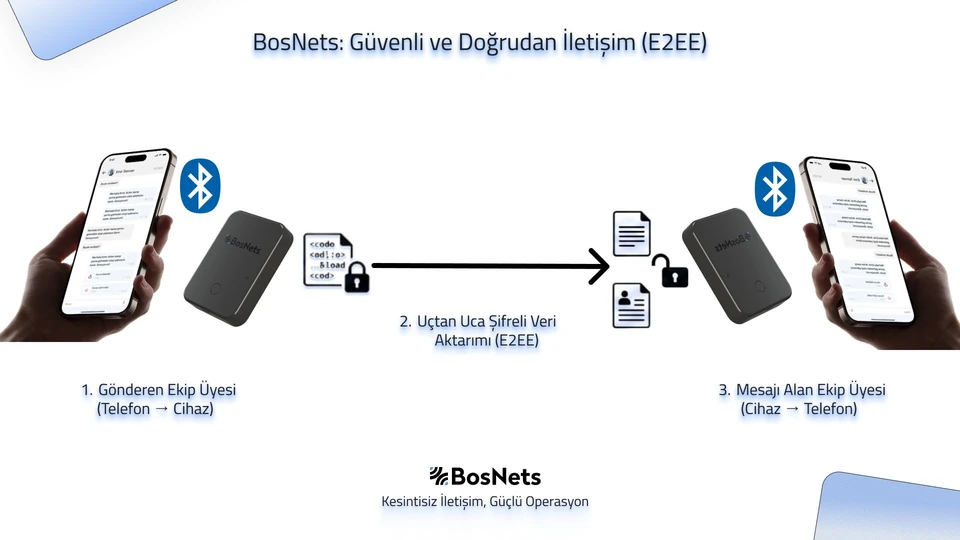
Leaving the technical side aside, the closest comparison is a sealed envelope. Your message is locked as it leaves your phone and can only be opened on the recipient's phone. Every point it passes through in between carries it without being able to open the lock.
That has an important consequence: the points in between do not know what the message says. Even when another device on the network is carrying your message across to the far side of the team, it cannot read it. The same applies to us; at BosNets we cannot see the contents of messages that pass through the server.
So confidentiality is not a promise. It is a consequence of how the system is built.
No dependency on outside infrastructure
In mesh mode the system consists only of the devices in the field. No telecommunications infrastructure is used, no satellite link is needed, and no data travels to a server abroad.
Besides letting the system work where there is no coverage, this gives a second property: because the network is nothing more than the devices the organisation physically has on site, it cannot be shut down from outside and cannot be listened to from outside.
The organisation runs the network
Who is on the network, who sees which group, and how the teams are divided are entirely the organisation's decisions. New teams can be brought in as the operation requires, and independent sub-groups can be created for different task units.
In practice it looks like this: the search team talks among themselves, the logistics team stays in their own group, and the coordination centre sees both through BosLog. Not everyone needs to see every message, but the centre needs to see the whole picture.
Keeping a record
After a critical operation, you need to be able to reconstruct what happened. BosLog collects and archives communication data, providing a record for after-action analysis, case review and, where necessary, legal processes.
This does not mean messages are decrypted. The organisation accesses the records of its own network under its own authority.
Frequently asked questions
Can BosNets read the messages?
No. Because communication is end-to-end encrypted, a message can only be opened on the sending and receiving device. We cannot see the contents of messages passing through the server either.
Does data leave the country in mesh mode?
No. In mesh mode the system consists solely of the devices in the field, with no external server or infrastructure involved. When working over the internet, the server side is infrastructure developed by BosNets.
Can we separate teams from one another?
Yes. Independent sub-groups can be created for different task units. One group's messages do not reach another, while the coordination centre still sees the whole picture through BosLog.
What happens if a device is lost?
Because network management is under the organisation's control, a lost device can be removed from the network. Messages it carried in the past are encrypted, so a third party cannot read them.