BosMag — Portable Communication Device
BosMag is a low-power portable communication device, smaller than a wallet, that attaches to a mobile phone with a magnetic holder. Its core function is this: to be your phone's way onto the network when there is no cellular coverage. The BosMag beside you finds other BosMag units nearby and forms a mesh network among them; because every device acts as both an endpoint and a relay, the covered area grows as the team carries more devices. It provides 5 km of range on a single hop in open terrain and 2 km in urban areas, carries long operations on a 48-hour battery, and produces your position through its built-in GNSS sensor without needing any network. No internet, SIM card or satellite link is required. It measures 7 × 6 cm, weighs 200 grams, attaches straight out of the box and pairs with BosApp over Bluetooth.
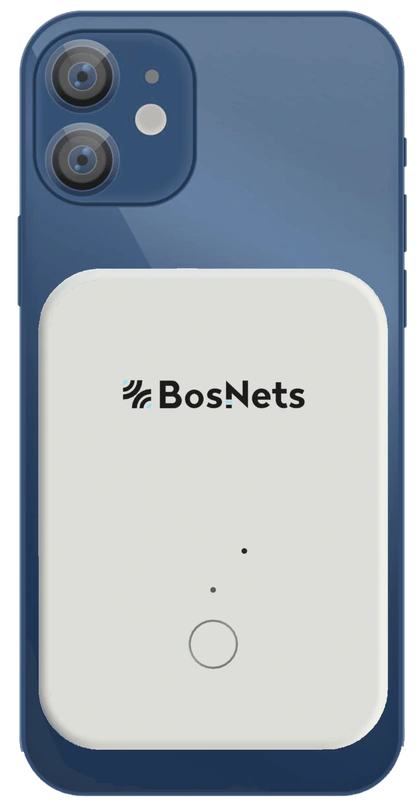
Technical specifications
- Device type: Communication device
- Network: Mesh radio frequency network
- Frequency: 869.4–869.65 MHz, licence-free band
- Range: 5 km in open terrain, 2 km in urban areas (single hop)
- Battery life: 48 hours
- Positioning: GNSS location sensor, 1.5 m accuracy
- Dimensions: 7 × 6 cm, 200 grams
- Phone connection: Bluetooth
- Attachment: Magnetic holder, fixes to a mobile phone
- Protection: IP68 — dust-tight and water resistant
- Encryption: Message contents are encrypted with AES-256
What it does
Keeps communication up when there is no network
After a disaster, base stations fail within hours; rural and mountainous terrain never had coverage to begin with. BosMag makes the phone capable of communicating again under those conditions. Text messaging, location sharing and emergency alerts work without any infrastructure.
Range grows with the team
This is where it differs from a fixed-range handheld radio: every BosMag that joins the network is also a relay. As the team spreads across the site, the devices in between carry the signal and the covered area expands on its own. Setting up a repeater is not a separate step.
Runs on a licence-free band, with no separate permit
The devices communicate on the licence-free 869.4-869.65 MHz band. That means an organisation does not need a frequency allocation or a licence fee; the system is legal to use straight out of the box. A step that is often a separate process with radio systems disappears entirely here.
An emergency button for when the phone cannot be reached
Pressing the emergency button on the device broadcasts an alert across the network; every screen shows the name, registered details and current location of the person who pressed it. It is designed for exactly the moments when someone cannot reach their phone — a fall, being trapped under rubble, or losing orientation.
Together with the BosNets product family
Frequently asked questions
Does BosMag work on its own?
BosMag provides the network layer and BosApp provides the interface. They are used together: the device attaches to the phone, and you message, share location and read the map through the app. The emergency button on the device itself works without touching the phone.
What does the range mean in practice?
These figures are the single-hop range between two devices: 5 km in open terrain, and around 2 km in urban areas where buildings are dense. When a team carries several devices the signal hops from one to the next, so the total covered area is larger than that. Dense structures, rubble and deep valleys reduce range.
Under what use does the 48-hour battery apply?
48 hours is how long the device stays active on the network under normal field use. Sustained heavy message and location traffic shortens it; on long operations the device can be charged in the field.
Do we need a frequency licence or permit?
No. The devices operate on the licence-free 869.4-869.65 MHz band; no frequency allocation or licence fee is required.
Do we need a SIM card or a subscription?
No. In mesh mode there is no SIM card, internet or satellite subscription required. Devices talk to each other directly. When a network is available the system will use the internet too, but it is not a requirement.
What is the BosNets field range without a base station?
Without any base station, the single-hop range between two BosMag devices is 5 km in open terrain and around 2 km in urban areas. A packet is carried over at most 5 hops inside the network, so the total area covered grows as the number of devices grows. A BosBase relay station reaches 20 km within its own range.
How much do BosNets hardware and software cost?
BosNets is priced per quotation: the figure depends on the number of devices, the network design and the support scope requested. For a quotation prepared for your organisation see the pricing page, or write directly to emirhan@bosnets.com.
Let's talk about how it fits your operation.