In field operations the worst case is not getting injured. It is being unable to tell anyone you are injured. That is exactly why there is a physical button on BosMag.
Being unable to ask for help
In field operations the worst case is not getting injured. It is being unable to tell anyone you are injured. After a fall, a slip, ground giving way, or simply losing your bearings, taking out a phone, unlocking it, finding the right person and typing a message is not always possible.
With gloves on it is harder still. In the dark, in the rain, with one hand occupied, harder again.
That is exactly why there is a physical button on BosMag.
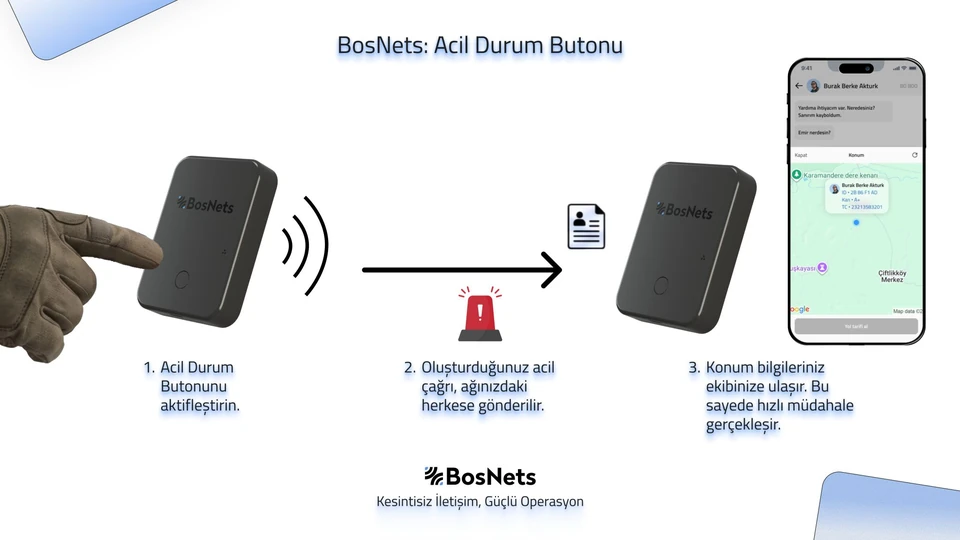
What happens when the button is pressed
- The alert goes out to the networkThe device broadcasts the emergency call without needing a base station. The signal hops from device to device until it reaches everyone on the network.
- The team sees who you are and where you areYour name, your registered details and your current location appear on everyone's screen. Nobody has to ask anything.
- The response beginsThe team takes routing to your location straight from the map and moves. The time normally spent describing where you are disappears.
Why a button on the device rather than in the app
Because using a phone in an emergency is not as easy as it sounds. The phone might be in a bag, the screen might be wet, your hands might be gloved, or you might not be able to reach it because of the fall itself.
BosMag sits on the back of the phone or on your vest, and the button can be found without looking at a screen. In a moment measured in seconds, that alone makes a real difference.
Why the signal gets through
The emergency call travels over the mesh network like any other message. Nothing has to be standing for it to arrive; the devices on the network relay it between themselves.
If someone is out of range, every teammate standing in between carries the call further. As the team spreads across the terrain that chain does not get shorter, it gets longer.
Not only for disasters
This matters as much for lone field personnel as it does for search and rescue teams. On construction, energy and mining sites, a person working alone being able to report their condition is a direct occupational safety issue. In outdoor sports, someone separated from the group being able to make themselves known is often the single most critical step.
Frequently asked questions
Does the emergency call work without a mobile network?
Yes. The call spreads over the network the devices build among themselves. No base station, internet or satellite link is needed. The signal hops from device to device until it reaches everyone.
Does everyone on the team see the alert?
Yes, it reaches every member of the network. The point is that you do not know who is closest at that moment, so the call should reach as wide a circle as possible.
What if it is pressed by accident?
The button is designed to resist accidental presses. If an alert does go out by mistake, the situation can be communicated to the team through the app.
How does the team find me?
Along with the alert, your name, your registered details and your current location appear on the team's screens. They can take routing to your position from the map and move directly.