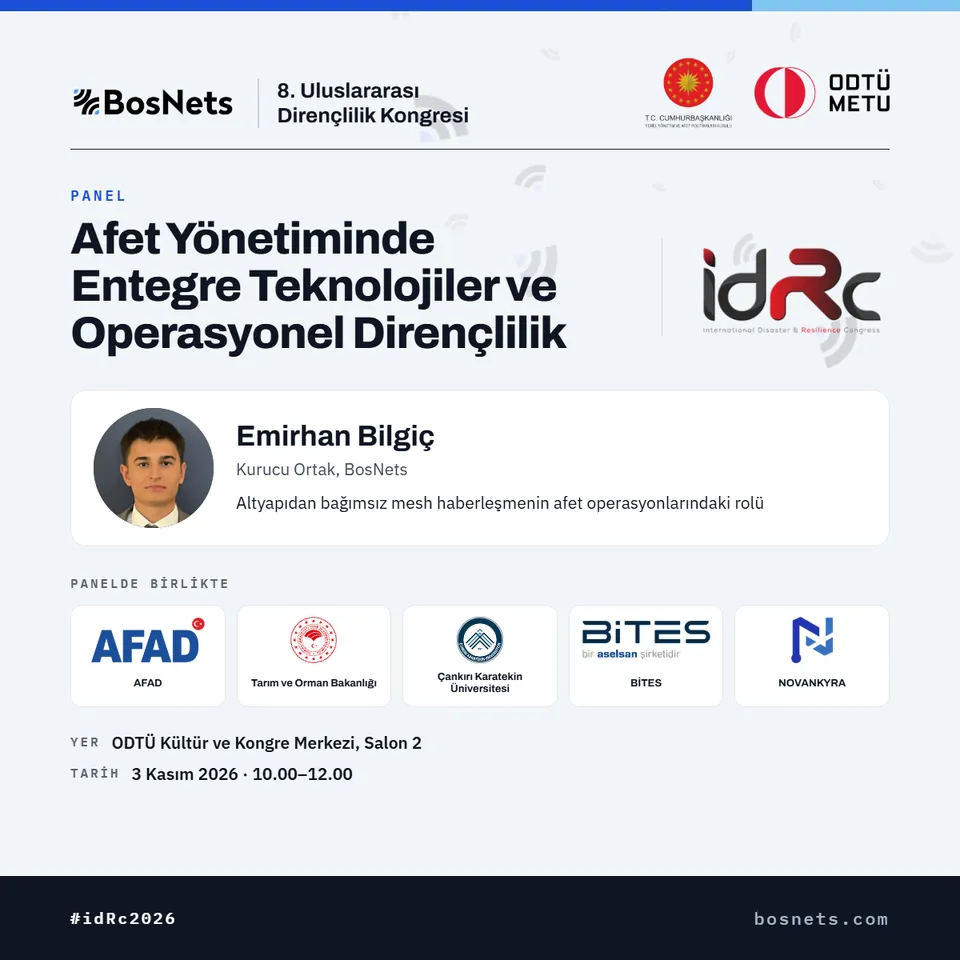
When disaster strikes, communication is often among the first things to fail. On 3 November at METU, at idRc2026, the 8th International Resilience Congress, that is exactly what we will be talking about: our co-founder Emirhan Bilgiç joins the panel “Integrated Technologies and Operational Resilience in Disaster Management” to discuss the role of infrastructure-independent mesh communication in disaster operations.
What is idRc2026?
idRc is the International Resilience Congress — International Disaster & Resilience Congress, as its logo spells it out — held since 2019 at a different university or institution each year. The eighth edition takes place in METU's 70th anniversary year and is led by the METU Disaster Management Implementation and Research Center: 2–4 November 2026, METU Culture and Convention Center, Ankara.
This year's theme is “Resilience in the Age of Information Technologies”. The congress brings a wide range of disciplines under one roof, from disaster management to geographic information systems, and from remote sensing to risk communication and urban resilience. The programme combines parallel paper sessions with thematic panels; according to the published draft programme, there are 48 sessions across five halls over three days.
The panel: Integrated Technologies and Operational Resilience in Disaster Management
The panel takes place on Tuesday 3 November, 10:00–12:00, in Hall 2. Public sector, academia and industry share the table: we join representatives from AFAD, the Ministry of Agriculture and Forestry, Çankırı Karatekin University, BİTES and NOVANKYRA.
The scope is broad: from disaster management centres to forest fires, and from flood and drought management to AI-driven solutions. What ties these together is a single question — how do different technologies become one operational picture in the field, and can that picture hold when the infrastructure is damaged?
Operational resilience starts with communication
Base stations depend on power, fibre backhaul and an intact building; when a disaster takes out any one of them, the network goes with it. In the 6 February earthquakes, 2,800 of the 6,350 base stations in the region went offline within seconds.
Keeping field teams connected, and getting field data to decision-makers when cellular infrastructure is down, is a cornerstone of operational resilience. However advanced it is, a disaster management centre can only decide as well as the information reaching it from the field. We cover this problem in detail in our guide to emergency communication after an earthquake.
Infrastructure-independent mesh communication
Emirhan Bilgiç's talk is about the role of infrastructure-independent mesh communication in disaster operations. BosNets answers that question in three layers:
- Without infrastructure: a device-to-device meshBosMag devices talk to each other directly over radio frequency, with no base station, internet or satellite, and form their own mesh network. Every device is also a relay point, so the covered area grows as the team grows.
- From the field to the centre: one operational pictureMessages, locations and emergency alerts reach the whole team through BosApp, and from there the BosLog screen at the coordination centre.
- With infrastructure: bridging and integrationWhen any point in the network has internet, that connection becomes a bridge for the whole network, so the team in the field and the centre far away stay in the same conversation. The switch happens without any action from the user.
We have tested this approach in the field, not just in the lab: at AFAD's drone search competition, which brought together teams from all 81 provinces, we ran BosApp and BosLog inside a real search scenario.
Join us at the panel
We invite all stakeholders interested in meeting our team and exploring potential collaborations during the congress to join us at the panel on 3 November. The congress programme and registration details are at idrcongress.org; if you would like to schedule a meeting in advance, get in touch.
Frequently asked questions
When and where is idRc2026?
The 8th International Resilience Congress (idRc2026) takes place on 2–4 November 2026 at the METU Culture and Convention Center in Ankara. It is led by the METU Disaster Management Implementation and Research Center in METU's 70th anniversary year, under the theme “Resilience in the Age of Information Technologies”.
When is the panel BosNets is part of?
The panel “Integrated Technologies and Operational Resilience in Disaster Management” takes place on 3 November 2026, 10:00–12:00, in Hall 2 of the METU Culture and Convention Center. It also brings together representatives from AFAD, the Ministry of Agriculture and Forestry, Çankırı Karatekin University, BİTES and NOVANKYRA.
What is infrastructure-independent mesh communication?
It means devices talk to each other directly and relay messages from device to device to form their own network, with no central infrastructure such as base stations, internet or satellite. In BosNets this is done by BosMag devices; when internet is available, the same network is bridged over it as well.