Today, 13 October, is the International Day for Disaster Risk Reduction: the day when awareness and preparedness take centre stage around the world, with one goal — reducing the losses that disasters cause.
Why does this day exist?
The International Day for Disaster Risk Reduction was designated by the United Nations and is observed every year on 13 October. Its message is simple: responding after a disaster is not enough; risk has to be reduced before the disaster arrives.
Earthquake, flood, wildfire or storm — whatever the hazard, its cost is not decided by the size of the natural event alone. To a large extent, it is decided by how prepared we are when it comes.
We cannot prevent disasters, but we can reduce their impact
We cannot always prevent disasters, but we can reduce their impact. The way to do that is to be prepared before they strike: sound buildings, known assembly points, a ready emergency kit, rehearsed evacuation plans.
The item that usually comes last on that list, yet is the one people reach for first in the opening hours, is communication.
The most critical part of preparedness: communication
The first hours after a major disaster are the most valuable for both rescue and coordination. Unfortunately, they are also when communication infrastructure tends to go silent: base stations are damaged, power is cut, and whatever network survives chokes under millions of people calling at once. We explain why this happens in detail in our article on post-earthquake emergency communication.
When infrastructure goes silent, the ability of teams to reach one another — and of people to reach their loved ones — saves lives. A team at a collapse site reporting to the coordination centre, a scattered team seeing where each member is, a family learning that someone is safe: all of it depends on one question — can we still talk when there is no network?
How BosNets works when infrastructure goes silent
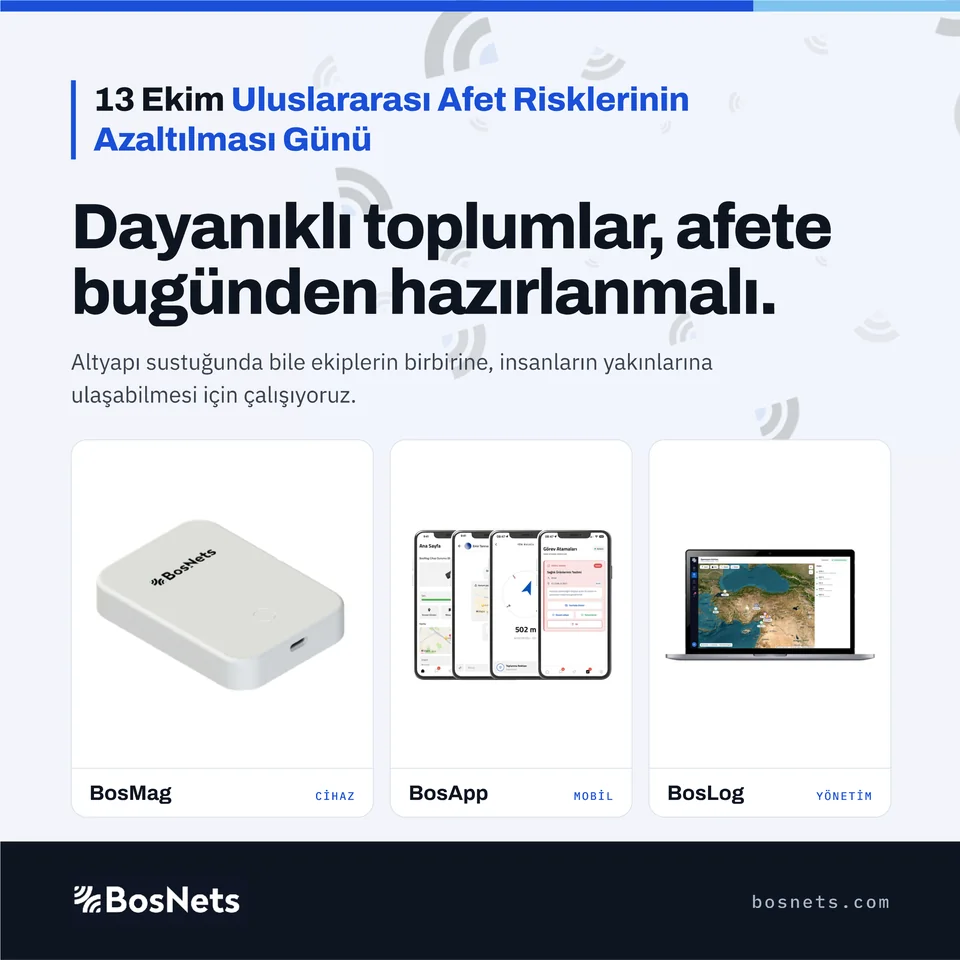
BosNets was designed so that communication does not depend on infrastructure. The system has three parts:
- BosMag — the device in the fieldA small device that attaches magnetically to a phone. It talks directly to other BosMags over radio frequency and builds its own mesh network. Messages are relayed from device to device until they reach the whole team.
- BosApp — the app on the phoneText messaging, offline maps, location sharing and an emergency call. Over the internet when it is available, over BosMag when it is not; the switch happens on its own.
- BosLog — the management screen at the centreGives the coordination centre a single view of the field: where the team is on the map, task assignments and a record of the operation.
When one end of the network has internet, that connection is opened to the whole network as a bridge, so the team in the field and the centre far away stay in the same conversation.
Preparedness happens today, not on the day of the disaster
There is no time to set up a new system or learn a new tool in the middle of a disaster. A tool that was never used in an exercise will not be used on the real day either. That is why communication preparedness, like every other kind, has to happen today: devices handed out, teams and groups set up in advance, the system tested in exercises.
At BosNets, we work so that communication holds even in the hardest moments. Because resilient communities prepare today.
Frequently asked questions
When is the International Day for Disaster Risk Reduction?
Every year on 13 October. Designated by the United Nations, the day promotes risk awareness and preparedness as the way to reduce the losses caused by disasters.
Why can the mobile network fail during a disaster?
Base stations depend on power, fibre backhaul and an intact building. In a disaster any of these can be damaged, power can be cut, or the network can be overloaded as everyone tries to call at once. The result is that communication breaks down in exactly the hours it is needed most.
How does BosNets work without a network?
BosMag devices talk to each other directly over radio frequency and form their own mesh network. Messages and locations are relayed from device to device until they reach the whole team, with no base station, internet or satellite required. When internet is available, the same network is bridged over it as well.